 English
 中文简体
中文简体 日本語
日本語 Español
ZAKER
Three Peel Strength Test Methods for Defining Quality Control Boundaries
A PU jacket develops collar blistering after washing, a sofa cushion coating begins to peel after long-term use, or an outdoor bag shows layer separation after exposure to water. These common product failures are often related to insufficient bonding strength between the coating layer and the base fabric.
However, a more hidden challenge exists in many manufacturing processes: some factories apply the same testing equipment and procedures to different types of synthetic leather materials. As a result, laboratory data may not accurately represent real service performance. Products with potential quality risks may pass inspection, while qualified materials may be incorrectly rejected.
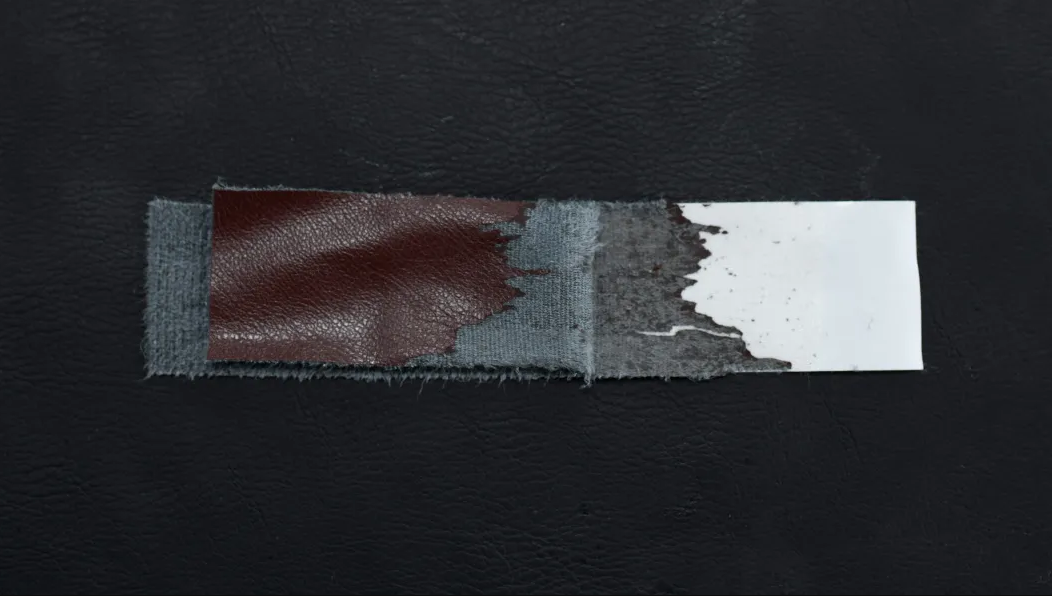
Why Do Different Leather Materials Require Different Peel Strength Testing Methods?
Although peel strength testing is designed to evaluate whether a coating and base fabric are firmly bonded, different leather applications require different testing approaches.
Why does apparel leather require manual pre-peeling before testing? Why does furniture leather often need hot-melt adhesive assistance? Why do water-exposed products require additional wet-state verification?
These differences are not simply operational preferences. They are based on the fundamental principles of peel strength testing.
Leather-like materials vary in thickness, flexibility, coating structure, and application environment. Therefore, appropriate specimen preparation methods and evaluation criteria are essential to ensure that test results accurately reflect potential failure modes during actual use.
Understanding the Principle of Peel Strength Testing
Peel strength is a quantitative measurement of the bonding performance between a coating layer and a base fabric.
During testing, a tensile tester separates the two bonded structures at a controlled speed. The average force value from the stable section of the peel curve represents the material’s ability to resist delamination during long-term use.
It is important to understand that the high initial peak force does not necessarily represent the true bonding performance of the material. Stable peeling force provides more meaningful information for evaluating durability and production consistency.
Based on standards including GB/T 8949-2025, FZ/T 73028-2017, SATRA TM 410, and Q/JK 1006-2023, peel strength testing can generally be divided into three standardized methods:
- Rapid peel strength testing method
- Standard testing and arbitration method
- Wet-state peel strength verification method
Each method includes specific sampling requirements, testing procedures, and evaluation principles to ensure reliable and traceable results.
1. Rapid Peel Strength Test Method — Hot-Melt Adhesive Method
Applicable Scenarios
This method is mainly used for rapid inspection during production processes, helping manufacturers quickly evaluate coating adhesion performance.
Supporting Equipment
- Microcomputer-controlled tensile testing machine
- Testing speed: 0-500 mm/min
- Maximum load: 500 N
- Accuracy: 1 N
- Pneumatic hot stamping machine
Standard Testing Procedure
Specimen Preparation
Three specimens measuring 150 mm × 30 mm are cut from the left, middle, and right positions across the full fabric width along the warp direction.
Hot-Melt Adhesive Treatment
Hot-melt adhesive is applied to the prepared specimens, leaving approximately 50 mm unbonded at one end.
The adhesive and specimen are aligned and bonded using a pneumatic hot stamping machine under the following conditions:
- Temperature: 130℃
- Pressing time: 3 seconds
After bonding, the specimens are cooled to room temperature.
Peel Testing Process
The unbonded ends of the hot-melt adhesive and specimen are fixed separately into the tensile tester clamps.
Testing conditions:
- Speed: 200 mm/min
- Test mode: Peel load
The tester is then started, and the peeling process is observed.
After complete separation, the average value from the stable section of the curve is recorded as the test result.
Result Calculation
The final result is calculated as the average value of three specimens, accurate to 1 N.
2. Standard Peel Strength Testing and Arbitration Method
Applicable Scenarios
This method is suitable for formal testing, quality evaluation, and arbitration purposes.
Supporting Equipment
Microcomputer-controlled tensile testing machine:
- Speed: 0-500 mm/min
- Maximum load: 500 N
- Accuracy: 1 N
Testing Procedure
Specimen Preparation
Three specimens measuring 150 mm × 30 mm are prepared, with the warp direction of the base fabric used as the length direction.
Testing Process
A clamp wider than 30 mm is selected.
The coating and base fabric are manually separated by approximately 50 mm. If manual separation is difficult, auxiliary methods such as alcohol soaking may be used.
The separated ends are fixed into the tensile tester clamps and peeled at a speed of 200 mm/min. The up to peel load is recorded.
Result Evaluation
If the coating layer breaks completely, the up to reading is taken as the peel strength value.
The average value of three specimens is used as the final result, accurate to 0.1 N.
If the coating and base fabric cannot be separated, or the peeling length is less than 50 mm, the sample is considered qualified.
Why Higher Peel Strength Is Not Always Better for Apparel Leather
For garment leather applications, higher peel strength does not always mean better performance.
Soft leather materials require a certain level of flexibility between the coating and base fabric. Excessively strong bonding may make the coating too rigid, increasing the risk of needle damage or tearing during garment sewing.
As long as the coating does not crack and blistering does not occur during use, the adhesion performance can be considered suitable for apparel applications.
For other industries:
- Luggage, sofa, and footwear manufacturers may refer to SATRA TM 410, where PU synthetic leather is bonded with a rubber carrier for testing.
- Space leather and upper leather applications may follow GB/T 8949-2025 procedures, where two PU leather specimens are bonded together, dried, and tested.
3. Wet-State Peel Strength Testing Method
Why Is Wet-State Testing Important?
For products exposed to water or moisture, dry-state peel testing alone may not fully represent real application conditions.
Water molecules can penetrate the interface between the coating and base fabric, weakening the bonding structure of polyurethane materials. A product with acceptable dry peel strength may still experience delamination after prolonged exposure to moisture.
Therefore, wet-state verification is recommended for:
- Outdoor seating materials
- Waterproof bags
- Rainwear materials
- Casual footwear
- Pool-related leather products
Supporting Equipment
- Microcomputer-controlled tensile tester
- Constant-temperature digital water bath
Testing Procedure
Specimen Preparation
Prepare appropriate dry-state peel test specimens according to the product application.
Water Treatment
Heat the water bath to:
60 ± 2℃
Place specimens into the water bath for 10 minutes.
Remove the samples, drain excess water, and perform peel testing according to the corresponding test procedure.
Result Calculation
The calculation method follows the corresponding dry-state peel testing standard.
Four Common Peel Strength Testing Mistakes in Synthetic Leather Quality Control
Mistake 1: Using Manual Peeling Methods for All Materials
Different synthetic leather products have different bonding characteristics.
For high-adhesion materials such as furniture leather, inconsistent manual peeling angles and speeds may damage the interface before testing, causing unstable results and affecting quality decisions.
Mistake 2: Performing Only Dry Peel Testing
Some materials may show good dry-state adhesion but experience significant performance reduction under humid conditions.
Without wet peel verification, water-exposed products may face increased quality risks during actual use.
Mistake 3: Using Peak Peel Force as the Final Result
The initial peak value on a peel curve is usually higher than the stable peeling force.
Using only the peak value may not accurately represent actual adhesion performance or provide useful guidance for production improvement.
Mistake 4: Applying Hot-Melt Adhesive Testing to Soft Leather Applications
For soft materials such as garment leather, the 130℃ hot-melt adhesive process may affect the internal bonding structure of PU coatings.
This can cause test values to differ from actual product performance and may influence quality evaluation.
Align Testing Methods with Real Application Conditions
From specimen sampling and pretreatment methods to testing parameters and result evaluation rules, every step of peel strength testing must match the final application environment.
Only when material performance, production cost, and testing reliability are considered together can synthetic leather manufacturers improve product stability and reduce peeling or delamination risks.
Accurate peel strength testing is not only a quality inspection process but also an important tool for building reliable synthetic leather products and strengthening long-term supply chain partnerships.
Contact
Tel: +400-686-9989
Fax: +86-0578-2867078
Email: marketing@zakernm.com
Website: www.zakernm.com
Address: No.9-1, Luyuan Road, Liandu District, Lishui, Zhejiang, China